From a series on the pursuit of comfort in the home written for ABC’s Blueprint for Living. You can listen to the audio here.
***
Everyone thought Bess Hardwick’s brand new house, Hardwick Hall in England, was amazing. More glass than wall, the rhyme went. And certainly, for the 16th century it was stunning, with huge, stone-mullioned windows covering much of the façade and flooding the interiors with light. The glass was handmade in small lozenges that were held together with strips of lead. But the miracle was as much about the lightness of the framework as the glass itself. It was, after all, a little like the great windows of the Gothic cathedrals except it was, rather remarkably, being used in a home.
That desire for huge windows has never gone away. The problem was that glass itself couldn’t be made in large enough sheets until the Georgian age and even then they had imperfections, rippled and bubbly in places. So you can you almost sense the excitement when new techniques began to arrive in the middle of the 19th century. Like the cylinder blown glass, where glass was formed in a cylindrical mould then sliced down its side where it unfolded in a kiln and could be pressed and polished into a flat piece of sheet glass. It was this method that was used to form the thousands of panes of glass that covered the frame of the famous Crystal Palace in London in 1851, a building that still inspires architects. By the early twentieth century, the idea of drawing molten glass out of its tank and through rollers (the Fourcault method of 1913) led to further refinements, meaning ever-larger panes of glass could be created. The modernist architects were in seventh heaven. Here now was a material that could be used without clumsy framework interfering with the purity of lines. Like Mies van der Rohe’s expansive windows of the Villa Tugendhat of 1929 that wrapped around its main living area, and Le Corbusier’s huge sliding doors at Villa Savoye outside Paris at the same time. Its extreme was seen in Philip Johnson’s Glass House of 1949 whose every wall is made from glass. Things got even better when Alastair Pilkington perfected the method of making float glass in 1952, meaning huge sheets of glass had virtually no imperfection at all. Architects everywhere clamoured to make walls disappear.
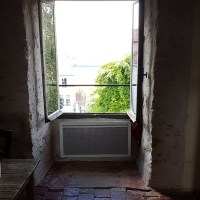
But what about comfort? Early issues of heat loss were addressed by double and triple glazing, an idea usually attributed to American Charles Haven in the 1930s although there’s evidence of rudimentary double glazing being used in Scotland, Norway and Switzerland back in the 1870s. Things have only improved. And yet the comfort of a room is often dependent on its enclosure. Here we encounter the clash of style versus comfort. It’s a question of balance. Because sitting, working or sleeping in a space that is wholly exposed to the outside is not an entirely comfortable experience. No surprise, then, to learn that Johnson’s house is actually a guesthouse, intended only for visitors, and that its glassy equal, the Farnsworth house, designed the same year by Johnson’s hero Mies van der Rohe, was also designed as a weekender. The simple fact is that comfort is often created through a sense of being held, as though the home has its arms around you. A glazed room can feel like sitting in the middle of a football field, your senses alive to everything around you, which becomes tiring over a long period. So maybe, in our search for comfort, we have overstretched ourselves and been carried away by technological advances, being swayed by what is possible rather than guided by what is comfortable. Windows are the perfect arbiters of comfort, a measure of how we might expect to feel in the home. Windows to the soul of the home, even.



loved this, thank you xxx when I was younger I loved big windows but as I’ve got older more comforting more enclosed spaces are preferable. My mums house on the river has a combination and that is very comfortable. Big windows facing the river are gorgeous in the day, but are particularly wonderful at night with all the lights reflected in the water.
LikeLike