Recently the Japanese tourist authority asked Australians heading to Japan to consider travelling off the beaten track. I suspect it’s not only Australians they’re asking, either, but certainly the Land of the Rising Sun is amazingly popular with Aussies at the moment. The problem is that there are simply too many tourists clogging up hotspots like Kyoto and Tokyo, just as there are elsewhere in cities like Barcelona and Venice. And it’s one of the reasons that I put together a tour that is crammed with wonderful architecture and great design, both traditional and modern, but with a focus away from the main cities. It’s even subtitled, ‘Off the beaten track’, which should please the Tourist Authority no end. (For more details, see the end of this post.)
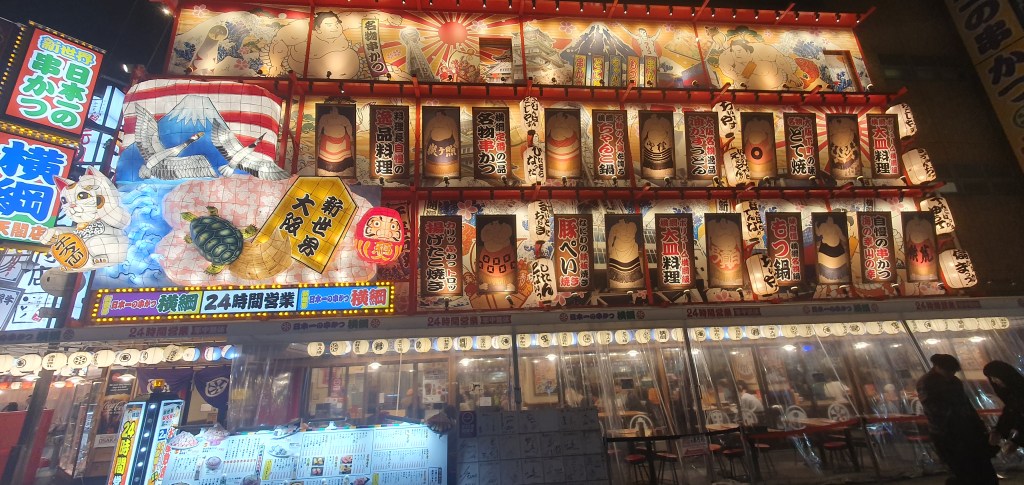
In my most recent trip to Japan, we went off the beaten track and started with an old favourite, Koyasan, or Mount Koya. It’s a sort of sacred hill station close to Osaka and a World Heritage Site to boot, filled with over a hundred temples, many of which take overnight guests. And yet, despite being an obvious draw for tourists, it manages to maintain its dignity. We first visited in 2018 and stayed in two different temples (Yochi-in and Shojoshin-in) and it was an experience that remained with us long after.

And so, when we booked flights into Osaka, it was a no-brainer to head for Koyasan again. I crossed my fingers that it hadn’t lost its special atmosphere in these tourist-laden, post-covid years.
Getting there simply adds to its otherness. You take a little train from busy central Osaka to the town of Hashimoto and transfer to an even smaller train that trundles along a winding track, stopping at tiny hamlets and picturesque villages set in dense forest, until you reach the end of the line. A cable car then takes you up the steep track to Koyasan. This funicular had itself been updated since our last visit, replaced with more modern carriages, so I began to feel nervous about further changes up the hill.
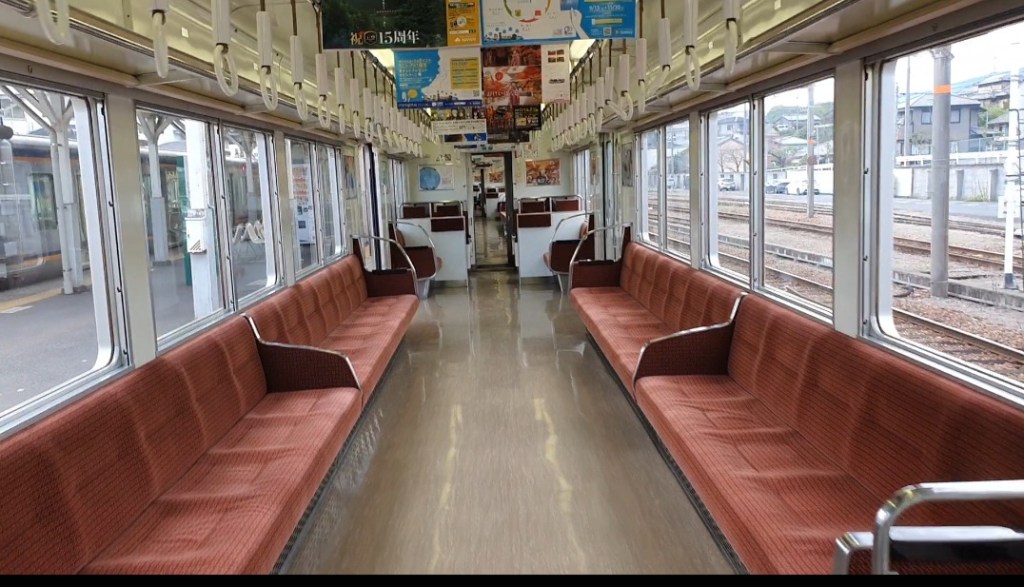
In 2018, our journey from Osaka had been in a packed train with standing room only. This time, it was virtually empty and the station master even met us to escort us to the waiting cable car. Perhaps this was because we were travelling in the middle of the day, after the tourist rush.

On the way, we had a familiar and very Japanese experience. A rather ancient couple sat opposite us from Osaka, and we smiled and nodded. They had obviously been shopping, given their many bags, and eventually the old man leaned forward and asked the usual question – which country? They seemed delighted when we said Australia. After a while and rifling through their bags, he leaned forward again and presented us with a beautifully packaged box. Gift, he said. It was a small square of butter cake, beautifully wrapped in a box and tied with ribbon, obviously bought at one of the chic little cake shops near the station. We protested but knew better than to refuse it. It happened that we’d bought two Breton butter cakes from Paul, the French bakery, so we gave one to them in return. I’m not sure that was the right thing to do. They looked taken aback and I wondered if we had broken a rule, upsetting the balance of showing a welcome to foreigners, but at least no one went without butter cake.

Koyasan is all temples, being the seat of Shingon Buddhism, brought to Japan from China in the 800s. This time we were staying in Fukuchi-In, a collection of beautiful buildings set in wonderful grounds.

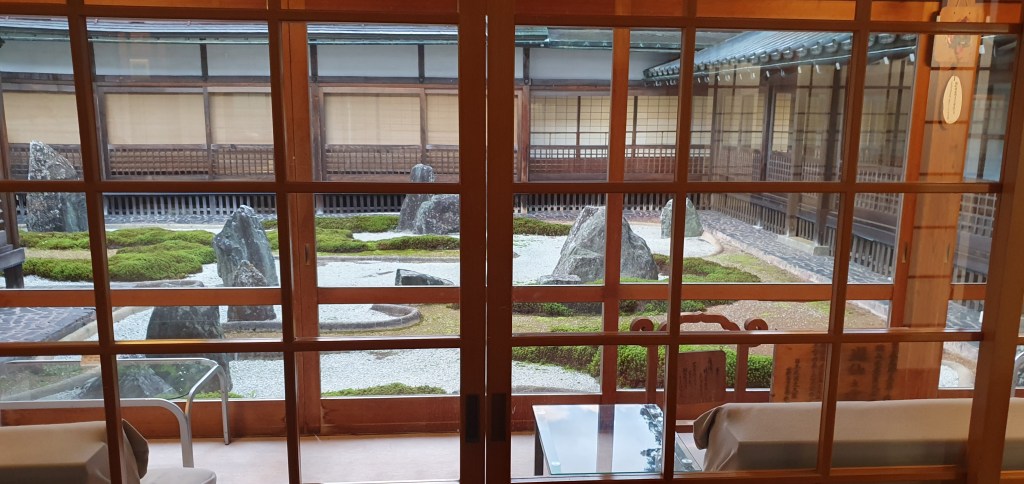
It was big enough to accommodate tour groups, which meant it was busier than we’d hoped, so it’s worth checking smaller temples first if quietness is your thing. It was still magical, though, with views over its different gardens.
The village is strung mostly along a single street. At one end stands the imposing Daimon, a huge wooden gate first built in the 11th century as a formal entrance.

At the other end is, I think, one of the most magical places on earth, known as Okuno-in.

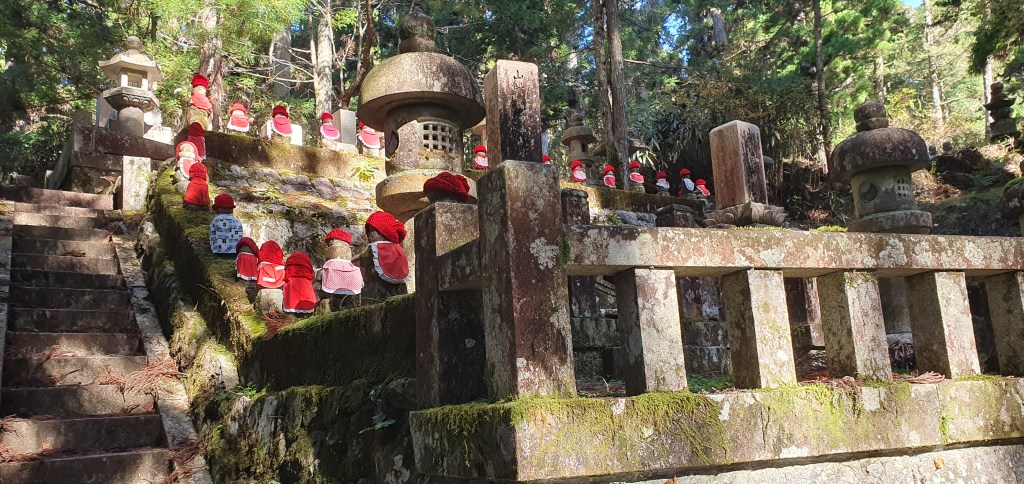
Here sits the mausoleum of the founder of Shingon Buddhism, Tobo Daishi, but what makes it so remarkable is the two-kilometre path that leads to it, through a forest of towering cedar trees.


Alongside the path and stretching out into the surrounding forest are thousands of tombstones and religious markers. It’s an extraordinary sight.
It shows how the introduced Buddhism co-existed with the existing Shinto religion, which is all about the spirits of nature. Shinto shrines are almost always hidden among the trees and we later visited its most important shrine at Ise, which is surrounded by magnificent old trees. It makes for a fairytale atmosphere, a touch of Sleeping Beauty, but it also creates something that is both soothing and uplifting. If I were religious, then I think Shintoism would get my vote.
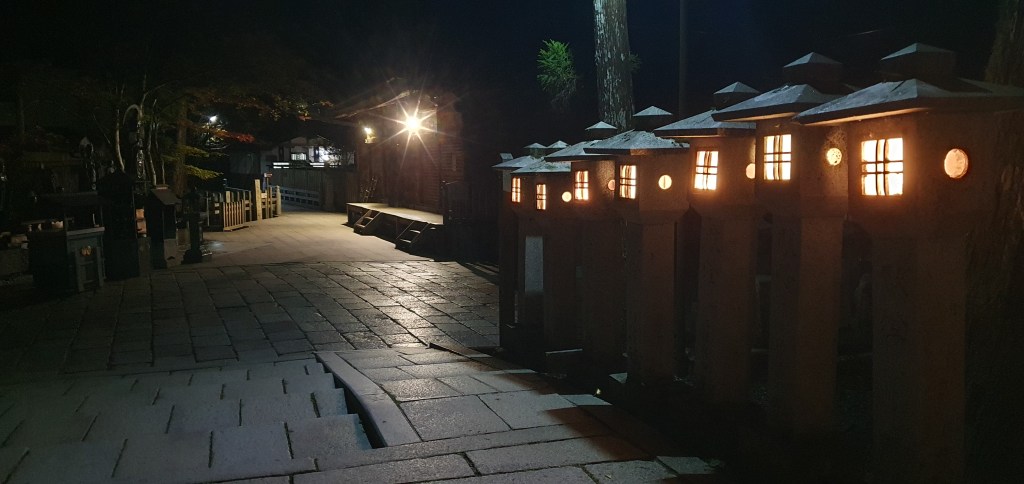
One of the absolute joys of staying in Koyasan is that you can wander around Okuno-in in the evening when the place is virtually empty and the winding path is lit by stone lanterns. Spooky for some, perhaps, but truly memorable.
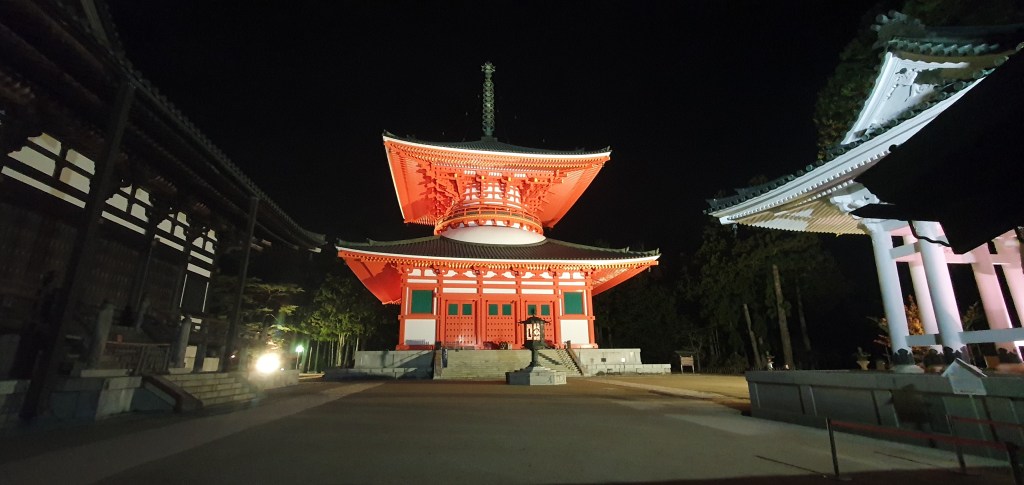
Your senses are fed at every step at Koyasan. The main Danjo Garan complex has a towering vermillion-coloured pagoda, and it’s another marvellous place to visit in the dark when everything is lit up.

Many of the temples are open to visitors, or at least you can poke your head through their main gates to appreciate the gorgeous old buildings and exquisite grounds.

I think we must have visited every one of them, marvelling at the brilliance of the red maples and the yellow gingko trees in full autumn splendour.

I love the huge roofs of the temples, often covered in cedar shingles or thatch made from bark.

Timber is used everywhere, both inside and out, finely worked into delicate screens or as structural beams and columns, joined without nails, and left unpainted.
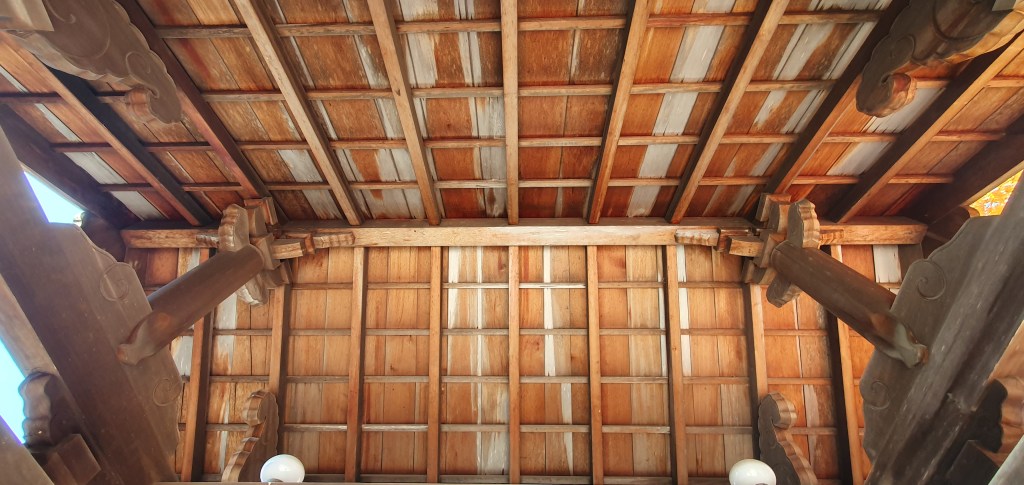
Timber is vital to Japanese architecture, referenced even in modern city buildings with wooden screens or a timber post. It’s a nod to tradition, and a link to the forest (that Shinto energy again).
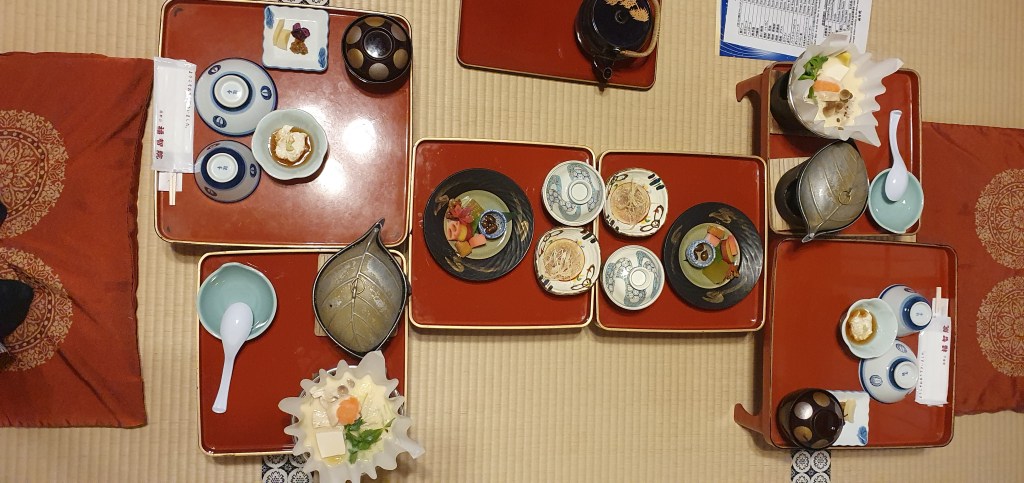
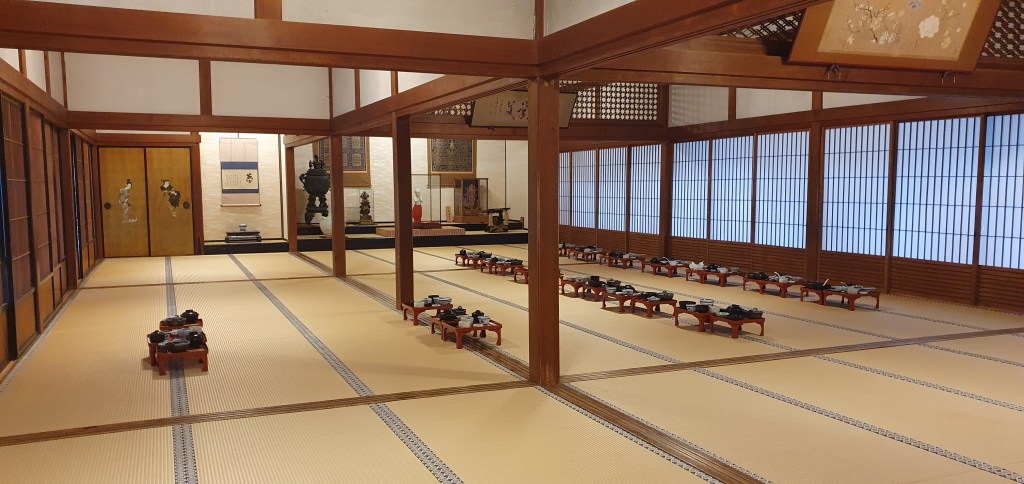
Staying at a temple means temple food, and that means vegetarian. Japanese vegetarian food is some of the best I’ve eaten. Much of it is based on dashi, the broth that is unique to each cook, blending herbs, vegetables and seaweed with soy to get just the right balance of umami, sweet and salty. Dinner runs to several courses, all of it beautifully presented. We ate, sitting on the tatami-mat floor, in a room enclosed by shoji (screens). Larger groups ate in bigger spaces, thanks to the inventive way Japanese buildings can be endlessly re-configured by pushing back screens.
Fukuchi-in has a proper onsen with two communal baths, divided into male and female areas. Both used the natural hot spring water that bubbles up on site but one was naturally carbonated, which was a new experience to me. Tiny bubbles cling to your skin and the effect is incredibly soporific. It was the perfect way to relax before bed and warmed us after our post-prandial saunter through the chilly cemetery in our puffer jackets, scarves and beanies. We returned to find our futons laid out on the tatami floor, the soft down duvets encased in crisp white cotton. You don’t go to Koyasan for the night life. The temple gates were locked at 9pm, the place utterly silent not long after.

We started each day with prayers in the inner temple at 6am. In flickering candlelight, we sat with about thirty others as the abbot intoned the sutras and then gave a short sermon in Japanese. Smoke from incense curled around us and the soft light caught the brass and gold of the sacred vessels behind. It’s a dreamlike experience. When the service was over, we were free to inspect the various holy objects more closely, markers of the past and sustainers of current traditions along with offerings of fruit, flowers and always incense. The veranda doors were opened so that we could linger on the timber veranda and watch the rising sun catch the tops of the surrounding cedar trees. It’s a beautiful way to start the day, well worth rising for at 5.30am. (On an art historical note, the main garden outside the inner temple was criss-crossed by concrete lines, which reminded me of the chequerboard garden by Gabriel Guevrekian at Villa Noailles at Hyeres in the south of France of 1929. This was a possible influence as the gardens at Fukuchi-in were designed at a similar time by master garden Shigemori Mirei who loved all things French. Google it and see if you agree.)

Koyasan may not be very far off the beaten track but it’s definitely quieter than the cities. It seems to have survived the onslaught of tourism, perhaps because its traditions mightn’t suit tourists who prefer international food and a Western bed. It’s not on my tour this year (although it would be an easy side-trip if you flew into Osaka) but it highlights the marvel of places away from the main tourist hubs, something the tour will deliver in places like Matsuyama and Takamatsu. I was heartened to see how Koyasan remains a place that defies the Western world, maintaining its ancient ways while welcoming those who seek the solace of beauty. We stayed only a couple of nights before heading south to one of Japan’s more beaten tracks, the Kumano Kodo, a pilgrimage route that is twinned with the Camino in Europe. The energy of Koyasan stays with me still. And that, I suspect, is what good tourism is all about.

For details of my tour, Architecture and Design, off the beaten track in Japan, head to www.jonbainestours.com.au.
Where in the world have you found unexpected joy?
 Colin Bisset
What an atmospheric post! The vignette of the cake exchange on the funicular is so very Japanese.
If I ever make it back to Japan, I would love to follow your ‘off the beaten path’ tour. Away from the crowds is my preference and your lovely photos and descriptions certainly look enticing.
LikeLiked by 1 person
Thanks, Mel. It’s definitely more and more difficult to get away from crowds and so wonderful when one manages it. We were delighted, though, to find quiet corners in the busy cities, still, which are often the places that the inhabitants frequent. And of course I can’t think of anyone I’d like more than you on my tour. Do send clones, please.
LikeLike