My recent trip to Britain took me back to old friends. Not only the human kind but also the buildings of my childhood. My sister and I promised long ago that one day we would return to the town on the Welsh border where we grew up, and this year we managed it. There was a wonderful sentimentality in exploring familiar streets and remembering our lives there and who lived where, the places we spent most time. But there was something else. What I hadn’t anticipated was the impact of standing in the buildings of my youth. I realised that it was these that sparked my interest in architecture. And it suddenly seemed obvious to me that the churches in particular had held a special sway.


I was eager to visit the priory church of St Mary’s. As kids, my sister and I were in the choir and I wanted to see again the view from the stalls. It was instantly familiar although the dark wood had been sanded so you could now make out all the details. I remembered singing at weddings on a Saturday when we were paid a half crown, which felt like a fortune then, the big silver coin heavy in my palm. Now it sounds like ancient history, like being given a groat, and much grander than the paltry twelve and a half pence it was actually worth. Of course I knew then that the church was old, founded by the Normans back in the 11th century, but I’d forgotten the elaborate alabaster tombs, mostly fifteenth century. Pride of place today is a sculpture of Jesse, father of King David, carved in the 15th century out of a single piece of oak, which is of immense historical value but which I have no memory of ever seeing.

I enjoyed the familiar spaces, like the airy vestry where we put on our cassocks, and the side aisle as big as the nave. During boring sermons, we in the choir would sit before the stone pulpit and I would pass the time examining the carved bunches of grapes and fancy Gothic designs. My eye would follow the lines of the arches and up to the wooden ceiling. The building had seemed austere to me then but today it looked rather grand, everything cleaned up and properly displayed.
There were other places we visited as children but which I had forgotten. Like the cathedral in Hereford, which I misremembered as a very plain building, without the massiveness of York Minster or the elegance of Norwich cathedral, two buildings I came to know very well after we moved to Yorkshire and I went to university in Norwich.
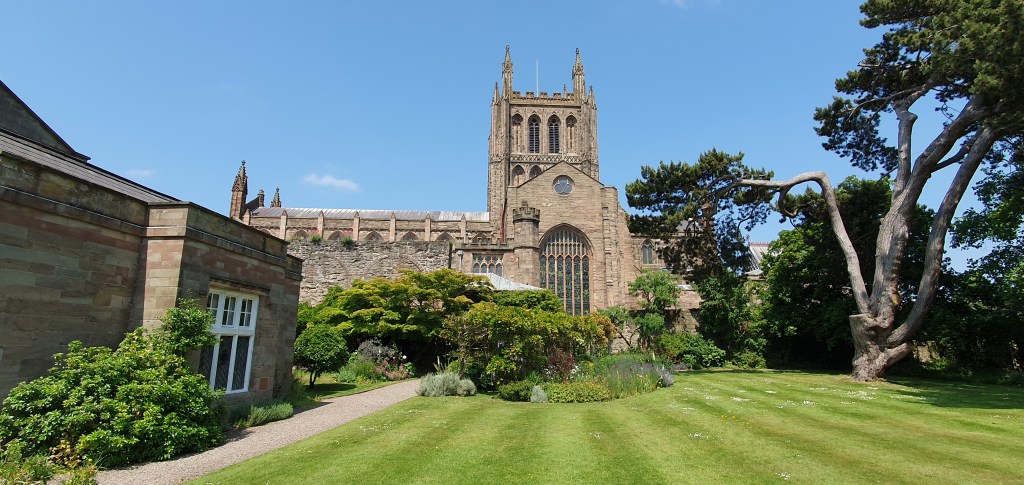

So I was taken aback by its ornateness. How had I forgotten the elaborate patterns on its Romanesque arches and its fine soaring spaces? I saw the wonder of its Mappa Mundi, the treasured medieval map of the world, and the chained library, where every book is fixed with links of metal to its shelf. None of that had meant anything to me as a child.
And then there was the tiny chapel at Partrishow, tucked away up a country lane.


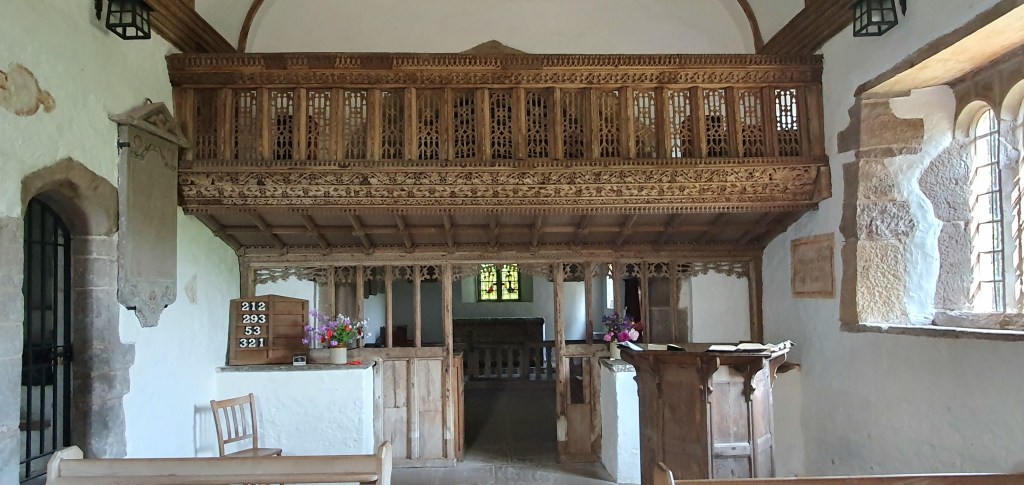
We would visit it occasionally as a family when we walked in the hills behind the Sugar Loaf, the volcano-shaped mountain that overlooks Abergavenny. I remembered it mainly because of the sinister wall painting of Time, a human skeleton holding a scythe and a spade, ready to cut you down and bury you. The painting was still there but I saw anew what an inspiring little space the chapel was, with its rich and intricately carved rood screen, and how beautifully it nestled into the hillside, almost daring you to find it.

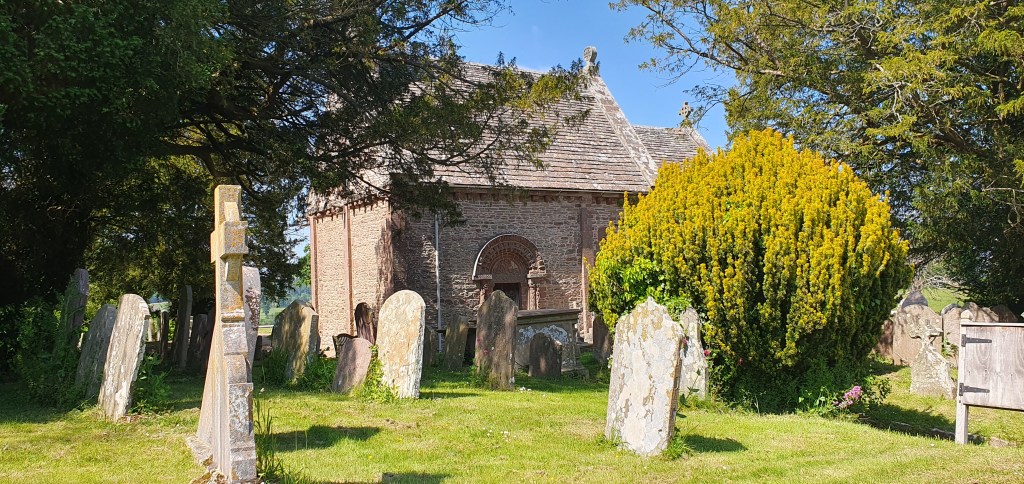
Even better was the chapel at Kilpeck, its abundant stone carvings dating from the twelfth century, showing the full force of human creativity in its imagined animals, faces and symbols.

And the surprising grandeur of Abbey Dore, its entire nave demolished when Henry Vlll wreaked revenge on the Catholic church.
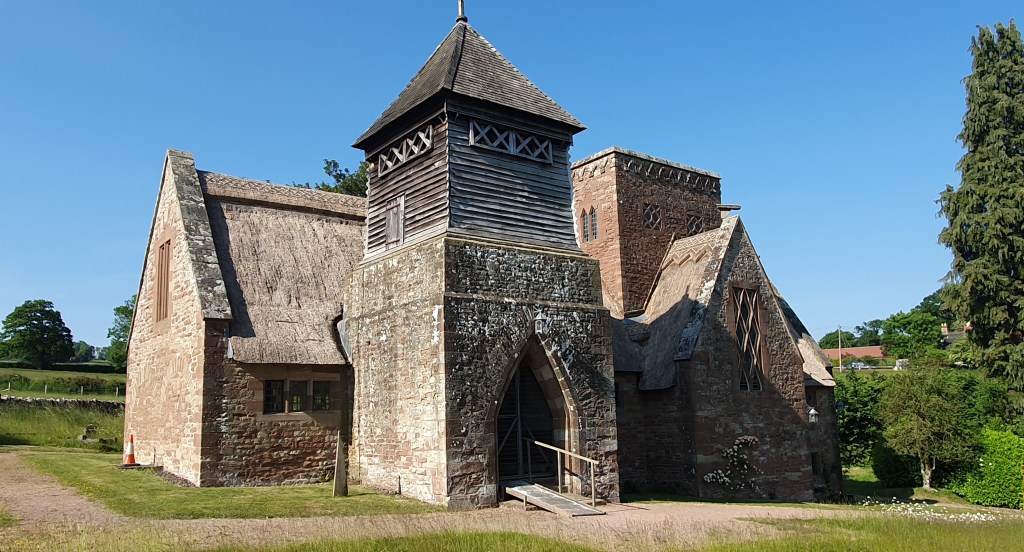
I saw new places, too, like beautiful Brockhampton, designed by William Lethaby, a hero of the Arts and Crafts movement, whose church demonstrates his love of symbolism, using cubes and pyramids and even a concrete roof tucked under softer thatch.


And nearby, a total surprise, a gloriously flamboyant church more suited to a Tuscan hillside than the tiny hamlet of Hoarwithy. St Catherine’s was designed by John Pollard Seddon, who mentored one of my favourite architects, CFA Voysey. The church floor and altar are covered in lavish mosaics and there’s stained glass by Burne Jones and Morris, making it a remarkable work to be so hidden away.
Although I am not religious, churches have always interested me. I like how they work with or against their surroundings, either trying to fit in, using local materials, or making a statement to show their importance, like the almost-brutal scale of St Peter’s in Rome. Mostly they do the latter, dotting the landscape with towers and spires.
Seeing buildings that I had taken for granted as a child now made me appreciate their power. I recognised that my love for buildings started with me simply sitting within them. Even the smallest chapel gives a lesson in the way it uses space, displays structure, and enhances the spirit of place. I’m sure I was unconscious of all that when I was a child but the lessons were still absorbed. Gradually my curiosity was awakened. It’s worth going back to see how far you’ve come.
What did the landscape of your childhood teach you?



I’ve lost my earlier unfinished comment so hopefully this isn’t too confusing 🙄. The landscape of my childhood was sadly short-lived. Our surroundings comprised a rapidly expanding housing development, and as a result the creek with its overgrown greenery and the local dairy with its majestic but terrifying Clydesdale horses (which pulled the milkie’s cart and frequently escaped from their paddock to thunder down our road as a herd) soon disappeared. But in the short time we could explore, it taught me to be adventurous, creative and a little bit gutsy even though Clydesdale horses still terrify me.
LikeLiked by 1 person
That’s quite a lesson! I reckon it’s a common experience, of land lost and freedoms curtailed. Revisiting Abergavenny this time, much of where I had played as a child had been built over… I shall think of your thundering horses when I pass our local Clydesdale up the road…
LikeLike
A wonderful article examine the influences of your childhood. Photos reveal the importance religion had in the region. True, it’s important (if possible) to revisit those sacred spaces.
LikeLiked by 1 person
Memory can often play tricks, indeed. You’re right, it’s good to go back and get a different perspective, and further embed them in our experience.
LikeLike
Well history did just repeat itself for me! That little church at Patrishaw I discovered by accident on a cycling tour of the Black Mountains in 1986. And I still have the photo of the figure of Death which I thought was amazing. I wouldn’t have been able to say where it was exactly so I’m happy you’ve pinpointed it for me all these years later 🤗 I too love churches despite being more pagan than Christian, the layers of history, the architecture, the spiritual vibes. Thanks for sharing your memories Colin.
LikeLiked by 1 person
Oh, that’s lovely! It’s such a hidden away place and it had lost none of its magic, although I think I first saw it in dripping rain so it had an added spookiness. Yes, it’s interesting how so many religious sites have a history that goes back much farther than Christianity.
LikeLike
You paint a delicious picture of torpid respectability driving you towards the bigness of the City and a hunger for difference. I suspect a different personality might simply have settled and thought ‘this is enough’. Thank heavens it was not!
LikeLike
Thank you for sharing your memories.
What is beautiful about so many of these places, is that most of the artisans who created them were sustained by their faith. visitors are moved by these expressions of faith, even if lacking faith themselves. Without it, we would not have these beautiful places today. Without its continuation, many will fall into ruin. Please support your local faith community – there will always be a very warm welcome.
LikeLiked by 1 person
Yes, indeed, faith and the money that was wrapped up in faith has been vital for the whole history of art.
LikeLike