We’ve got five more mouths to feed at the moment. Beaks, actually. After several months of being on his lonesome, Harry the guinea fowl now has a new family. Two of them are the traditional pearly-grey like him, two are what they call ‘lavender’, which is pale grey, and one is ivory, which is pale grey with creamy highlights. Putting these newbies in the coop, where they’ll remain for the next few weeks to acclimatise to their new home, took me right back to when I first started out with guinea fowl. That was over a year ago and gosh, it’s been quite a journey.

Why guinea fowl? Partly because they’re supposed to be great at eating ticks but mainly because I’ve always liked the look of them. The idea of a flock ambling around our place just seemed right. They are also relatively independent, happy to free range and then roost in their preferred tree. No fuss.
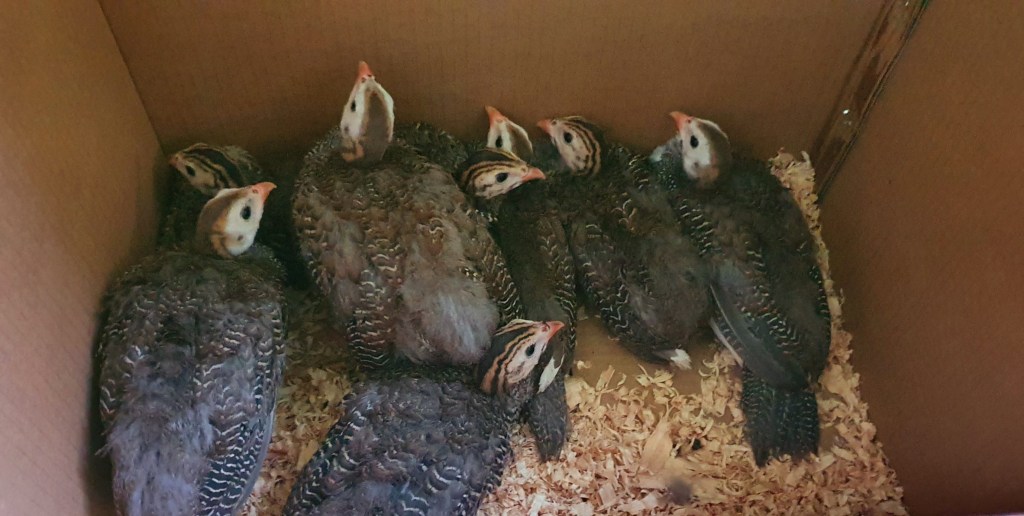
My initial order was for ten but only nine were delivered, barely eight weeks old and more fluff than feather. They had to remain in a coop for at least four weeks but those early days were fraught with anxiety, including an encounter with a hungry python. (That exploit is detailed here.) When they were old enough to be released, I lost a couple to foxes or maybe a goshawk. There were five for a while and then only four. Miraculously, given my record, that guinea fowl quartet lasted for months.

Sometimes they would follow me around (at a distance) but mostly they wandered down to the rose garden to peck through Anthony’s carefully-laid mulch. While they’re not as destructive as chickens, they still forage, often uprooting new plants in the process. Anthony was not impressed but I loved seeing them wandering about, just as I’d always imagined.

It turned out there were two females and two males, and naturally they paired up. By Christmas there were two nests hidden in the undergrowth, each overflowing with eggs. Motherhood didn’t come naturally to the first female, who scattered her eggs all over the place. None would hatch. The other female was more diligent and one spectacular morning I was overjoyed to see her wandering around the rose garden accompanied by two tiny chicks, or keets, as they’re known. Adorable. By lunchtime, however, they were gone. The mother had probably wandered too far for their little legs, and some predator had seized the moment. There were signs of life from the remaining eggs, including little ‘peeping’ sounds as the tiny beaks tried to break through the tough shells, but none survived.

Worse was to come when one of the females was killed by a goshawk, leaving nothing but a trail of feathers. It meant that there were now two males and one female. Not a good mix. The single male was kept at a distance by the other male, even though they continued to go around as a group. And then, early one foggy morning, I heard a great kerfuffle and looked out to see one of the guineas running around, screaming his head off. Foxes, probably, had managed to nab the paired couple. The single male had survived because he was kept at a distance.
I felt I had really failed my little birds. I hadn’t had them even a year. The chances of guineas being taken by predators is high, of course, especially as we have everything from goannas and pythons to raptors and foxes. But guineas can fly and are wary of every little sound. A noisy car can send them into a flap.
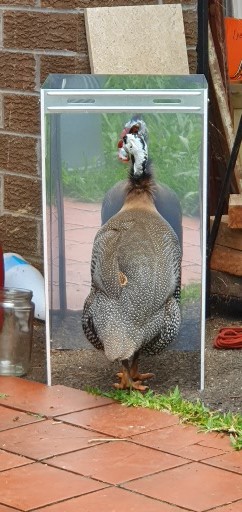
The sole guinea was a sad little fellow. For a week or so he would call out for his mates. He stuck close to the house and found company in his reflection in the glass doors into the kitchen and a shiny bit of metal in the garage. I knew I couldn’t keep him like that; guinea fowl need a flock. So I asked my neighbour if he would add him to his menagerie of guinea fowl, geese, chickens and even a peacock or two. The problem was that I couldn’t catch my guinea. I tried everything, from throwing a sheet to cornering him on the veranda but nothing worked. A friend said it was obvious he didn’t want to go anywhere. And when my friend Emily came to stay, she said I couldn’t possibly keep calling him ‘the guinea’ when he was now such an important part of our household and suggested the name Harry.
The bigger problem was that we were going away for two months. With Harry still evading capture, I realised I could do nothing but fill up the old feeder and hope he’d survive. I didn’t believe I’d see him again. And yet, two months later, we drove up to the house and there he was. It was the best welcome home. Not exactly hugs and kisses but he definitely perked up when he saw us.
I knew then that he belonged here and I needed to give him some new friends. So last weekend I collected five adults from a breeder. Harry seemed ecstatic, although there was a bit of aggressive pecking between him and the bigger lavender-coloured bird. I figured they’d sort it out over time. And that, really, is that.
Except that, just before posting this little piece, I went to refill the water in the coop and the lavender bully managed to escape. Almost immediately Harry chased after him and there was a fight, feathers a-flying. Within a few minutes, thankfully they seemed to reach an impasse. It’s early days but I reckon the newbie will hang around. He’s bigger than the others, a docile bunch, and I think being cooped up was really bothering him. The first night he slept in the palm tree by the house and today he’s moseying about the place, pecking for insects and calling out to the others from time to time. I think it’ll be fine.

But who knows. Life with guinea fowl is never straightforward.
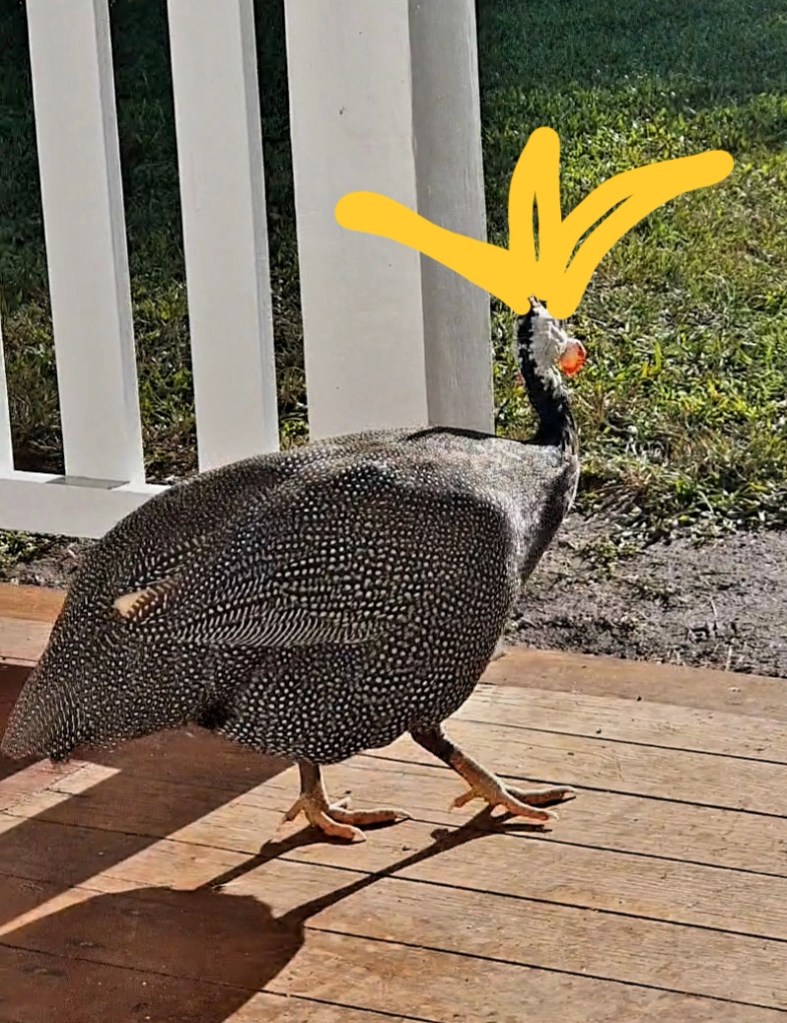
As for Harry, to me, he’s a beacon of resilience. Having witnessed the brutal loss of those he grew up with, now he has to contend with a new bunch of adults. He’s happy, though. I can tell. He hasn’t once looked at his reflection. There’s a lesson about the importance of community in that, surely.
What new responsibility have you taken on recently?



 Colin Bisset
An ultimately heart warming vignette. I hope for good times for Harry and co. Xx
LikeLiked by 1 person
I’ll pass your good wishes to him!
LikeLike
What a tough year for Prince Harry! He sounds like a survivor though, and worthy of his new flock. I do hope you/he manage to keep the various predators from the door. You are made of strong stuff!
And in answer to your question I suppose the only new responsibility I’ve taken on lately is our new house…here’s hoping it doesn’t get the better of me!
LikeLiked by 1 person
Given there’s a python sunbathing near the coop at the moment, it really is a matter of fingers crossed… Good luck with the house. Just tell it who’s boss…
LikeLiked by 1 person